
Bathroom lighting that works for real daily routines
Bathrooms are used early in the morning, late at night and often in a hurry, so the lighting has to be practical first. In Rosebank flats, Sandton homes and coastal houses in Durban or Umhlanga, we plan for shaving, makeup, bathing and cleaning without harsh glare or dark corners. A good bathroom scheme also has to cope with steam, humidity and frequent switching, especially where extractor fans are weak or windows stay closed in winter.
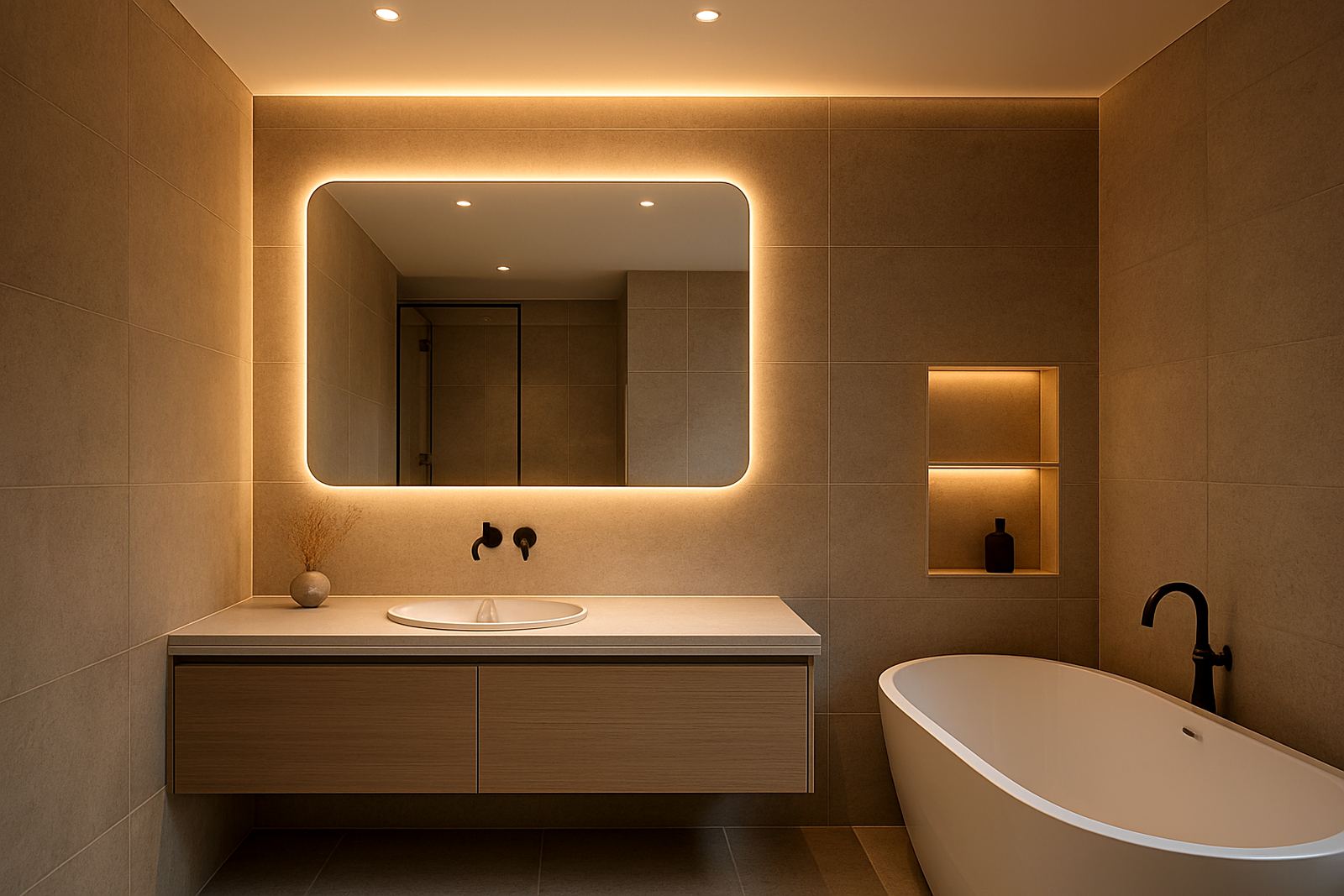
For bathrooms we usually start with the room size, ceiling height and mirror position, then work out where the light needs to fall. A small guest bathroom may only need a simple ceiling layout and mirror lights, while a main bathroom with a bath, shower and double basin may need three or four layers of light. The aim is clarity without the cold, clinical feeling that some bathrooms get when one bright fitting is used for everything.
- General ceiling light for overall visibility
- Mirror lighting for face level tasks
- Accent light for niches, bath edges or feature walls
- Night lighting for safe movement after load-shedding or at low brightness
Common fittings used in bathroom projects
The typical equipment set depends on the room, but most bathrooms need fittings that handle moisture and can be cleaned easily. In practice, that means sealed downlights, wall lights near mirrors, and sometimes LED strip lighting in joinery or under vanities. For homes in Pretoria and Johannesburg where daytime dust is common, we also look at fittings that are easy to wipe down without staining or yellowing. In coastal areas we pay extra attention to corrosion resistance and fixings that wont deteriorate quickly.
We often specify a mix of warm white and neutral white lighting, depending on the finish materials. If the bathroom has lots of marble, light tile or glossy paint, softer output helps stop reflections from becoming too sharp. For darker bathrooms or spaces with timber and textured finishes, a slightly stronger output can help keep the room bright enough without overdoing it.
- Moisture-rated recessed downlights
- Mirror side lights or top lights
- Linear LED for vanities or niches
- Dimmable switches or scene control
- Emergency or backup-compatible lighting where needed
We also check the switching plan early. In many homes the wrong switch position means the mirror lights are too far from the entrance or the shower light cannot be used without lighting the whole room. That kind of small mistake is easy to avoid if the layout is planned before wiring starts.
Layout advice for mirrors, showers and ceiling zones
Mirror lighting is where many bathroom projects go wrong. A single light above the mirror often throws shadows under the eyes and chin, which makes grooming harder. Side lighting at face height usually gives the best result, especially for larger mirrors. If side lights are not possible, a well-positioned linear fitting above the mirror can work, but it must be placed high enough to avoid glare and low enough to give even coverage.
Showers need careful thought too. A fitting placed directly above the shower can be useful, but only if it is suited to moisture and positioned so that steam does not shorten its life. Bath areas can benefit from softer accent light, especially in family homes where the bathroom doubles as a place to relax. For homes in Midrand, Pretoria and Cape Town, we often use separate zones so the room can run at full brightness for cleaning and at a lower level in the evening.
- Keep mirror lights at face level where possible
- Separate shower, mirror and general lighting on different circuits
- Avoid placing fittings where cabinet doors or tall mirrors block the light
- Allow enough spacing so the ceiling does not feel crowded
- Check IP rating and mounting detail before installation starts
In smaller bathrooms, less is often better. Too many fittings can make the room feel busy and create patchy light. A neat, well spaced plan gives the room a calmer look and makes it easier to maintain too.
Moisture, heat and load-shedding planning
Bathrooms are tough on light fittings. Steam from hot showers, poor ventilation and frequent on off use all shorten the life of cheap components. That is why we always look at the wet and dry zones in the room and decide where each fitting can safely go. Ceiling void depth matters as well, especially in renovated homes where there may only be limited space above the plaster board.
With load-shedding still part of everyday life in South Africa, bathroom lighting should also be thought through for backup use. If the home has inverter supply or battery support, we can help choose low-draw fittings that keep the bathroom usable without draining power. In some cases a simple night light circuit is enough, but in larger homes it is worth planning for a few essential lights to stay on. This is especially useful for early morning routines or family homes with young children.
We also coordinate with other trades where needed, because tile changes, vanity joinery and mirror sizes all affect the final result. Once the tiling is done and the mirror is already ordered, there is very little room to fix a lighting mistake without extra cost.
Mistakes we see in bathroom lighting projects
A common mistake is using one bright ceiling light and expecting it to do everything. Another is choosing decorative fittings that look good in a showroom but do not cope with moisture or are difficult to clean. We also see mirror lights mounted too high, which causes shadows and forces people to lean in awkwardly. In a bathroom that is used every day, these problems become annoying very quickly.
Another issue is ignoring the colour of the finishes. White tiles can reflect a lot of light, while dark stone or charcoal paint can absorb it. Without checking the room materials, the result can feel either washed out or too dim. The same applies to small bathrooms in apartments and larger main bathrooms in homes around Sandton or Cape Town. Scale matters. So does spacing.
- Do not rely on one central fitting only
- Do not place mirror lights too high above eye level
- Do not ignore steam and corrosion exposure
- Do not choose fittings before the layout is confirmed
- Do not forget dimming or night lighting where useful
If the room is being renovated, it is worth pausing before the final electrical fixings go in. A small adjustment now can save a lot of frustration later.
Budget ranges for bathroom lighting in Rand
Bathroom lighting budgets vary a lot depending on room size, number of fittings and whether the project needs custom detailing. For a simple guest bathroom, a practical lighting package can start from about R3 500 to R7 500, excluding major electrical upgrades. That might cover basic moisture-rated ceiling lights, a mirror solution and standard switching.
For a mid-range family bathroom with separate zones, dimming and a better quality finish, budgets often sit between R8 000 and R18 000. Larger main bathrooms, double vanities, feature mirrors and custom control can move into the R20 000 to R45 000 range or more, especially where joinery, backup power coordination or special finishes are involved. Installation complexity, site access and the need to work around finished tiles can also affect the total.
We help clients in Johannesburg, Pretoria, Cape Town, Durban and Umhlanga choose where to spend and where to keep things simple. The best value usually comes from getting the layout right first, then selecting fittings that suit the room and the way it is used.
How Illumin8d approaches bathroom projects
At Illumin8d, we handle bathroom work as part of a full lighting plan, not as an afterthought. Our team in Rosebank includes Mandla Ndlovu, Ayesha Patel, Johan van Wyk, Lerato Mokoena, Sibusiso Dlamini and Nokuthula Khumalo, and we cover design, fixture specification, layout plans, control design and installation coordination. For bathrooms, that means we can plan the look, the practical light levels and the technical details together.
Clients usually contact us through the enquiry form on our contact page, then we work through the room dimensions, finishes and use case. Whether the bathroom is part of a home in Johannesburg, a townhouse in Midrand or a coastal property in Umhlanga, the goal is the same: light that feels calm, clear and built for everyday use. A bathroom should be simple to use, easy to maintain and comfortable at all hours, not just when the room is new.