
Lighting that suits the pace of a busy bar
A bar is not lit like a dining room or a retail shopfront. The room has to feel lively after sunset, but staff still need to pour drinks, read labels, wash glassware and move safely around the counter. In Johannesburg and Pretoria, where many venues trade through power cuts and late trading hours, the lighting plan must also cope with load-shedding and quick restarts.
We start by looking at the service points, the customer flow and the finish materials already in place. Dark timber, mirrors, brass, exposed brick and stone all react differently to light. The aim is to stop glare on bottle shelves and polished counters, while keeping enough brightness at the till, POS point and prep zone. In smaller bars, one badly placed fitting can make the whole room feel flat or too harsh.
Typical fittings used in bar projects
Most bar schemes combine layered fittings rather than one type of light. That gives depth and lets the room change from early trade to peak service. The exact set depends on ceiling height, brand style and how much light is coming in from the street during the day.
- Recessed downlights for general light at circulation areas
- Track spots for bottle displays, artwork and feature walls
- Linear LED strips under counters, shelves and banquettes
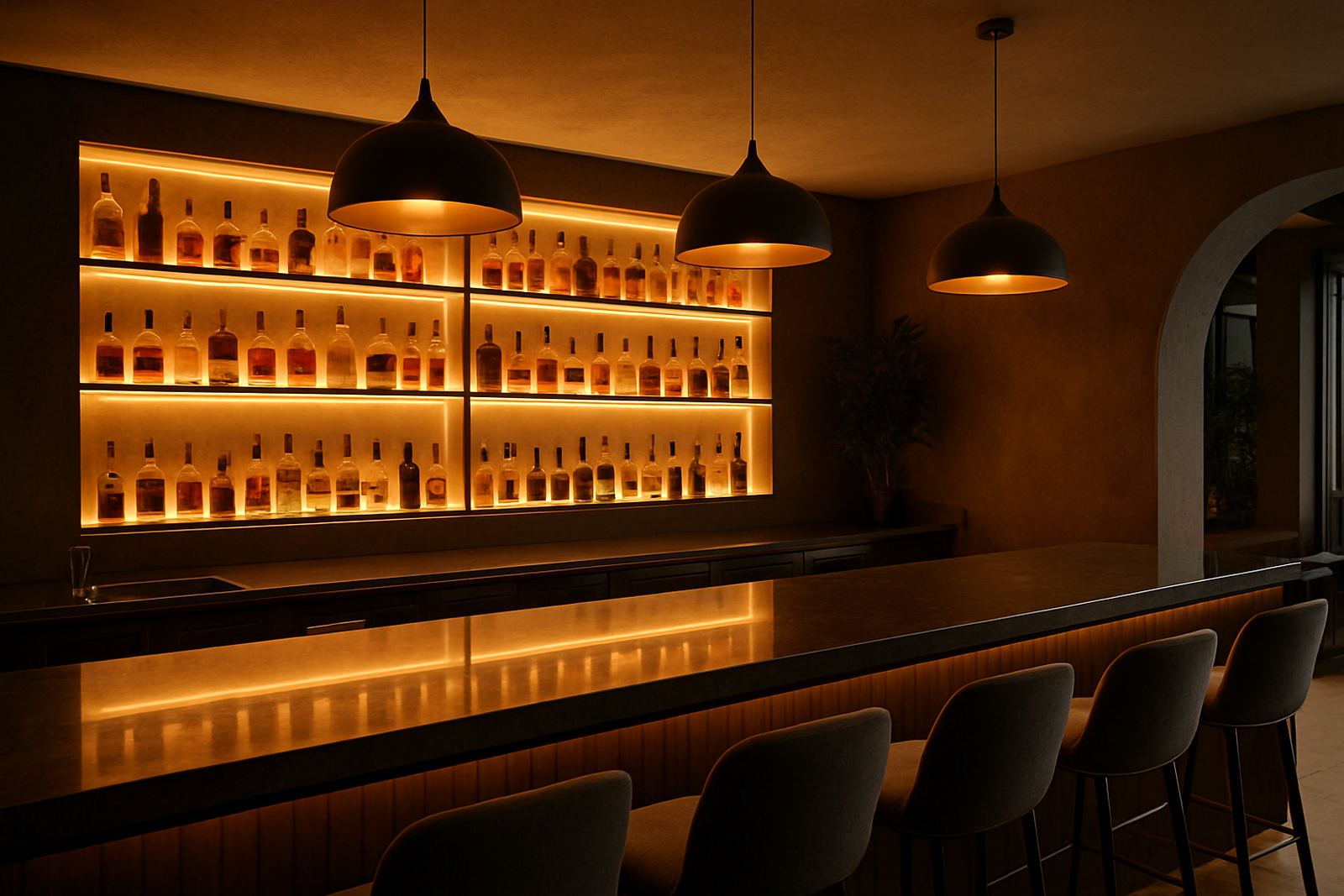
- Pendant fittings above feature tables or the main bar
- Accent lights for signage, menus and framed finishes
- Emergency fittings and exit lighting where required by the venue layout
For coastal venues in Durban or Umhlanga, we also pay attention to corrosion resistance and sealed drivers because humidity can shorten the life of poor-quality gear. In Cape Town, salty air near the Atlantic side can do the same. Equipment choice matters, not just the appearance.
Layout planning around the counter and seating
Good layout begins with the counter line. The bartender should not work under direct glare, and customers should see the drinks without the shelves becoming a bright mess. A common mistake is placing spots too close together, which creates hot patches and strong shadows across faces. Another mistake is pushing decorative fittings too low, where they interfere with sightlines or head clearance.
We usually plan lighting in zones: entry, bar top, back bar, seating and service. That makes it easier to dim the room in the evening while keeping the work zone readable. In a narrow bar, wall washing can make the room feel wider. In a larger venue, feature pendants or focused spots help break up the space and stop it from feeling like one long bright strip.
- Keep the back bar brighter than the seating area
- Use dimming so the room can move from daytime to evening trade
- Avoid placing fittings where glass reflects directly into the eyes
- Leave enough access for cleaning and lamp replacement
- Coordinate fittings with mirrors, shelves and menu boards before installation
How decorative lighting supports brand identity
Bars often depend on mood and memory. A customer should remember the glow on the bottles, the finish on the counter and the way the room changes after dark. That is where custom design matters. A neighbourhood gin bar in Rosebank will not need the same approach as a rooftop venue in Sandton or a beach-side spot in Umhlanga, even if both are serving the same drinks.
We work with material samples, mockups and fixture specs so the light colour and beam spread suit the finishes. Warm white light usually works well for timber and leather, while slightly cooler light can support a cleaner modern look. We also check the effect of any coloured feature lighting, since too much colour can flatten skin tones and make the room feel less welcoming. The best result is one that supports the brand without shouting over it.
Common mistakes that cost money later
Many bar projects look fine on opening night and then become a problem within a few months. Usually it is because the lighting was treated as the last item on the list. That can lead to poor cable routes, fittings that cannot be accessed for maintenance, or control gear hidden where heat builds up.
The other common issue is under-lighting the service areas. Staff then add portable lamps or leave back of house lights on all night, which pushes up running costs. On the other side, over-lighting the customer area can kill the atmosphere and make the venue look more like a canteen than a place to stay for a second drink. A proper site lighting audit helps catch these problems before they become expensive.
- Using fittings with no dimming strategy
- Skipping emergency lighting until the end of the project
- Choosing decorative pieces before checking ceiling structure
- Ignoring heat around drivers and transformers
- Forgetting about maintenance access above the bar
Budget ranges for bar lighting in Rand
Budgets vary a lot depending on the size of the room, the quality of fittings and whether control systems are included. For a compact bar or small restaurant bar, a lighting refresh can start around R35 000 to R75 000. That usually covers selected fittings, some new circuits and basic dimming.
Mid-size venues with feature walls, back bar lighting and better controls often fall between R90 000 and R220 000. Larger bars, hotel venues or premium fitouts can move from R250 000 upward, especially where custom fabrication, detailed control design and installation coordination are needed. If the site is in an older building in Johannesburg or Cape Town, allow extra budget for remedial work, because existing wiring and ceilings are not always ready for a clean install.
A sensible allowance for post-install focusing and adjustments also helps. Small changes on site can make a big difference to how the room feels once the furniture and bottles are in place.
What to expect from our bar lighting process
At Illumin8d, we handle bar projects from concept through to post-install focusing. Based in Rosebank, Johannesburg, we work across Johannesburg, Sandton, Pretoria, Midrand, Cape Town, Durban and Umhlanga. Our team includes Mandla Ndlovu, Ayesha Patel, Johan van Wyk, Lerato Mokoena, Sibusiso Dlamini and Nokuthula Khumalo, which means the design, technical detail and site work stay aligned from the start.
Clients usually begin with an enquiry through the contact page. From there, we assess the brief, talk through the venue use and prepare a lighting direction that suits the space and the budget. Whether the project is a new venue or a refresh of an existing bar, the goal stays the same: strong atmosphere, practical service light and a room that works all night.
- Concept design matched to the venue style
- Fixture specification based on durability and output
- Layout plans for service and guest zones
- Control design for dimming and scene changes
- Installation coordination and on-site focusing