What facade grazer lights do on a building face
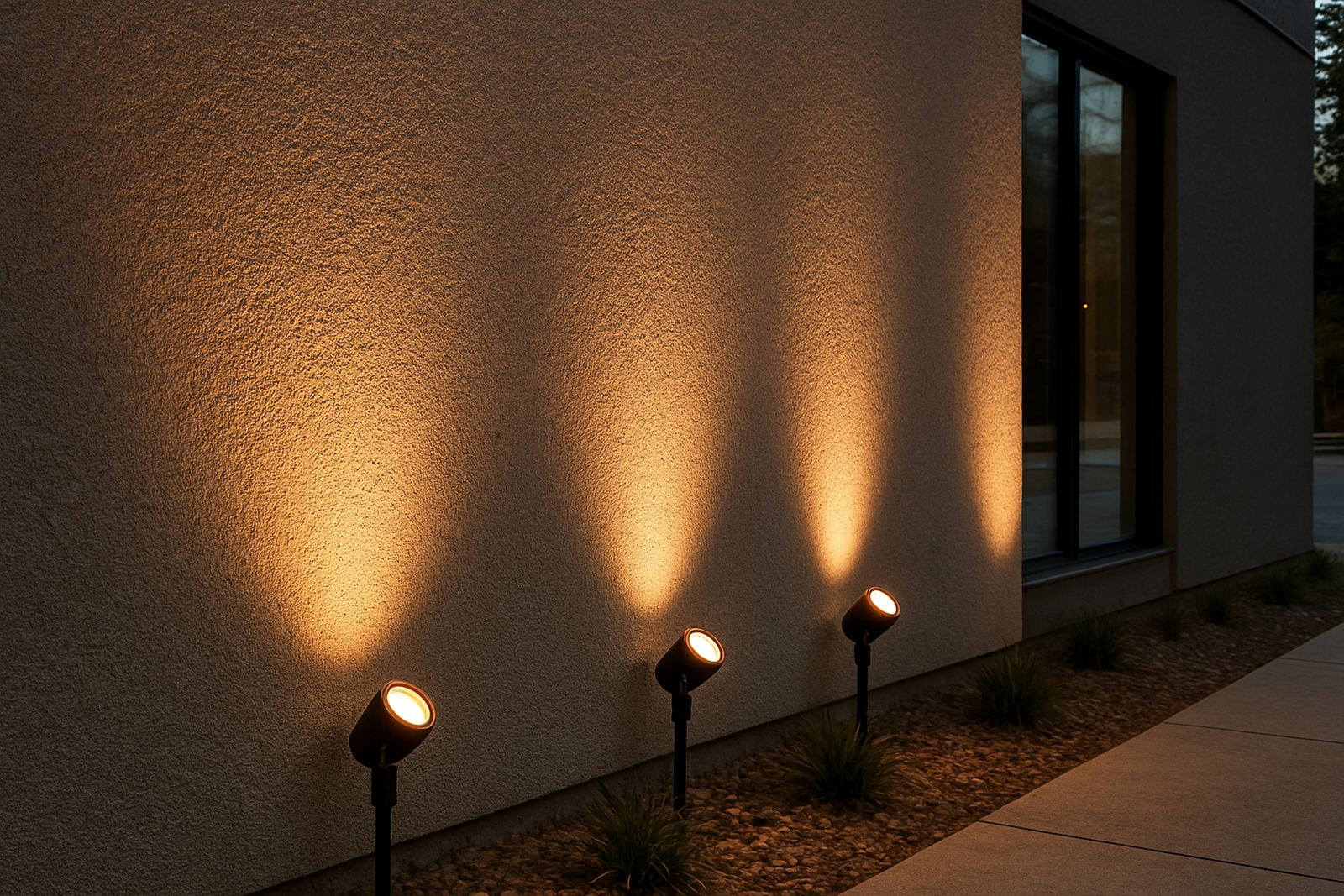
Facade grazer lights are narrow beam exterior fittings placed close to a wall so the light skims over the surface rather than flooding it from a distance. That grazing action brings out the highs and lows in brickwork, split stone, fair-face concrete and profiled cladding. On the right surface, it can make a plain wall read as a strong design feature after dark.
They are often used where a shopfront needs clear night identity, where a restaurant wants warmth and depth from the street, or where a home owner wants the front boundary, entrance wall or courtyard to feel more considered. The effect is different from general flood lighting. You are not trying to light the whole building evenly. You are shaping shadows and texture, which is why the beam angle and spacing matter so much.
For South African sites, facade grazers also need to cope with practical conditions. Coastal humidity in Durban and Umhlanga, dust in Pretoria, and load-shedding related switching all affect how the system is specified and installed. A good layout starts with the wall finish, the height of the mounting point and how the property is used at night.
Sizes, beam spreads and finish options
Facade grazer lights are available in compact linear lengths and small individual fittings, depending on the wall width and the effect required. On smaller home entrances, short modules around 300 mm to 600 mm can be enough. For larger shopfront elevations or long restaurant facades, 900 mm, 1200 mm and longer continuous runs are more practical. The key is to keep the beam consistent across the surface.
Typical beam spreads include tight grazing beams for rough masonry, and slightly wider controlled beams for smoother plaster or rendered finishes. On very textured brick, a tighter beam usually gives better definition. On cladding or smooth stone, too tight a beam can create harsh lines, so the spacing may need to be opened up.
Common options include:
- Aluminium bodies for better heat control and outdoor durability
- Powder-coated finishes in black, bronze or custom colours to suit the elevation
- Warm white or neutral white LED output, usually 2700K to 4000K
- Low-voltage or mains-powered units, depending on the project
- IP65 or higher for exposed exterior positions
We also look at glare control. If the fitting sits too far out or aims too high, you can end up seeing the source instead of the wall texture. That is especially important near road frontages, parking areas and residential entrances where neighbours may be affected.
Where facade grazers suit best
Facade grazers suit any project where the exterior material deserves attention at night. They work well on brick perimeter walls, shopfront pilasters, restaurant feature walls, garden facades, boundary walls and home entrances. On commercial sites, they are often used to pull a brand frontage forward without relying on oversized signage lighting.
In hospitality, the light can help create a calmer evening atmosphere. For a restaurant in Rosebank or Sandton, that may mean a warm grazing effect on textured plaster or stacked stone at the entrance and terrace. In Cape Town, where cooler coastal light and wind exposure are part of the brief, the fitting choice and mounting detail need to be more careful. In Durban and Umhlanga, corrosion resistance is especially important close to the sea.
They are also useful on homes where the owner wants the house to feel secure and welcoming without bright floodlights. A properly grazed wall can mark the entrance, guide visitors and make the building easier to read from the street. It is a practical light, but also a design feature.
- Shopfronts with brick, stone or concrete branding walls
- Restaurants with outdoor dining areas or entrance features
- Homes with perimeter walls, gate pillars or stair walls
- Courtyards and covered verandas that need texture at night
- Buildings with a clean architectural finish that should not be overlit
Installation, spacing and power requirements
Facade grazer lights need careful placement. The usual starting point is to set the fitting close enough to the wall for the beam to skim the surface, then test the throw on site before fixing the final positions. A small change in setback can change the whole look. The wall height, texture and colour all affect the result, so mockups help a great deal on new builds and refurbishments alike.
For power, these are electric LED fittings. No gas is required. Most projects use mains power with suitable outdoor-rated drivers or transformers, although low-voltage systems can be useful where access for maintenance is limited. On sites affected by load-shedding, it is worth planning the lighting circuit so it can connect neatly into backup power if the client wants evening continuity.
Installation should always follow the site conditions and municipal rules, especially where exterior cabling, conduit routing and mounting on shared boundaries are involved. On coastal sites, sealing and fixings need extra attention. Stainless or corrosion-resistant hardware, proper cable glands and weatherproof junctioning help prevent early failures. If a façade has insulation boards or rendered sections, the fixing method must suit the substrate rather than just the finish layer.
Care, cleaning and servicing over time
Facade grazers do not need heavy maintenance, but they do need regular checks. Dust, spider webs and salt deposits can build up on the lens and change the beam pattern. On city properties and coastal sites, a gentle clean every few months helps keep the wall lighting even. Avoid harsh cleaners that can cloud the lens or damage seals.
It is also worth checking fixings after the first few months, especially on walls that take strong wind, vibration from traffic or seasonal movement. In Johannesburg and Pretoria, dust can settle around fittings faster than many owners expect. In Durban, moisture and salt air can shorten the life of poor-quality components if the unit is not sealed properly.
When a project is well specified, servicing is mostly about keeping the light output consistent and replacing individual drivers or modules if needed. LEDs last well, but electrical surges, water ingress or incorrect dimming can still affect performance. A quick inspection before winter and again after the rainy season is a sensible habit for most sites.
What to check before you order
Before ordering facade grazer lights, it helps to confirm a few practical details so the result matches the building and the budget. The wall finish matters first. Rough brick, stone and board-marked concrete usually need a different beam from smooth plaster or painted cladding. You should also measure the available mounting height, the length of the wall and any obstructions such as beams, gutters, signs or security grilles.
Other details worth confirming include the colour temperature, the finish colour of the fitting, whether dimming is required and whether the site needs low-voltage or mains power. If the building is near the sea, ask for corrosion-resistant hardware and ask how the unit is sealed. If the project is a shopfront, check that the light will not spill into the street or cause glare at eye level.
- Wall material and surface texture
- Mounting height and available setback
- Desired colour temperature, warm or neutral
- Control method, switch, timer or dimming
- Exposure to rain, salt air, dust or strong sun
- Maintenance access for future cleaning and servicing
At Illumin8d, we help clients choose the right grazer layout for the building, not just the fitting. That includes concept design, fixture specification, layout plans, control design, mockups and samples, installation coordination and post-install focusing. The aim is a wall that looks intentional at night, not overlit or patchy.
Key facts
| Application | Exterior wall grazing for brick, stone, concrete, plaster and cladding |
|---|---|
| Common lengths | 300 mm, 600 mm, 900 mm, 1200 mm and custom continuous runs |
| Beam angle | Narrow grazing beams to controlled wider beams, selected to suit the wall finish |
| Colour temperature | 2700K, 3000K, 4000K |
| Ingress protection | IP65 or higher for exposed outdoor use |
| Power | LED electric supply, typically mains or low-voltage with suitable driver |