
What fitting room lighting needs to do in a retail space
Fitting room lighting is not just about putting a lamp above a mirror. It has to flatter the face, show clothing colour accurately and keep shadows from making garments look uneven. In a shopfront this matters because customers often decide whether to buy after trying an item on, especially where fit and finish are important.
At Illumin8d we plan fitting room light around the rest of the store lighting so the transition feels natural from floor to mirror. A customer should not walk from a bright sales floor into a dark cubicle that makes skin look washed out or creates harsh under-eye shadows. The aim is simple, better comfort and better purchase confidence.
- Even light across the face and torso
- Low glare on mirrors and glossy finishes
- Good colour rendering for true garment colour
- Enough brightness for detail checking without feeling clinical
Fixture types and sizes that work in changing rooms
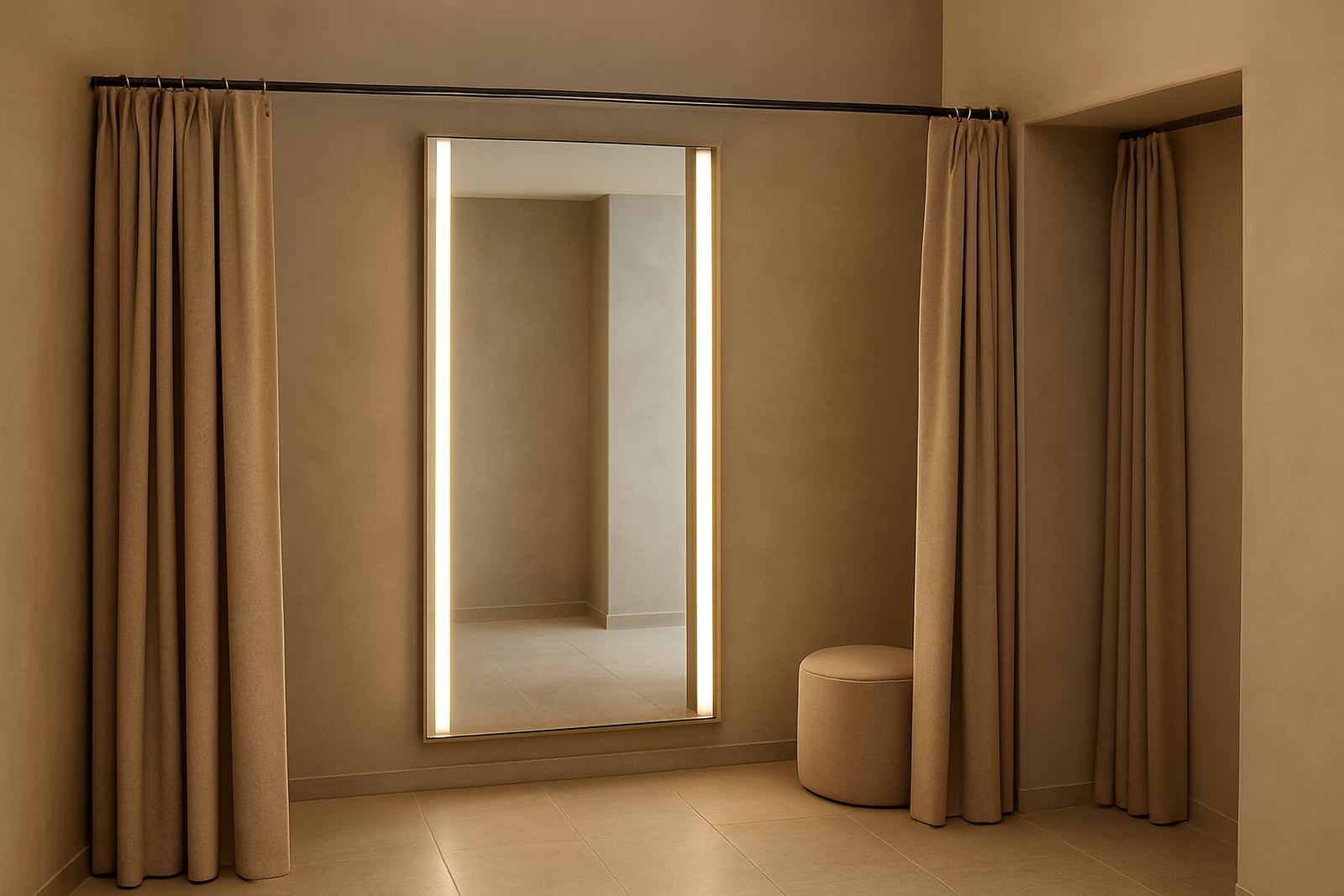
Most fitting rooms suit slim linear fittings, recessed downlights or vertical mirror-side lights, depending on ceiling height and wall structure. In small change rooms, a pair of vertical light bars beside the mirror often gives better results than one fitting overhead. In larger cubicles, a ceiling-mounted centre light can be combined with side light to reduce shadow on the face and shoulders.
Typical sizes are compact enough for standard retail cubicles, but we can also design custom lengths for wider mirrors or larger fitting areas. For a single cubicle, a 600 mm to 1200 mm fixture often works well. For double-width rooms or premium fitting suites, longer runs may be more suitable. Dimmable options are useful for boutiques that want softer light for evening trade and brighter output during the day.
- Compact fittings for 900 mm to 1200 mm cubicles
- Longer linear options for wide mirrors and premium rooms
- Recessed or surface mounted options depending on ceiling build
- Warm white, neutral white or tunable white output depending on the store concept
Where fitting room lighting suits best
These fittings suit clothing boutiques, menswear stores, ladieswear stores, sportswear retailers and family fashion outlets. They are also useful in bridal shops, formalwear stores and speciality retail spaces where customers need to inspect garment finish closely. In Johannesburg and Sandton, where premium retail fitouts often need a polished look, lighting detail can make a clear difference to how a space feels. In coastal areas like Umhlanga or Durban, fittings need to handle humidity and be selected with the right materials and finish.
Fitting room light also works in mixed-use spaces such as stylists, personal shopping suites and high-end home dressing rooms. For home use, the same principles apply. The light should support natural skin tone and make it easy to match clothing under different daylight conditions. If a room has no natural light, the fixture choice matters even more.
- Fashion retail and boutique fitting rooms
- Bridal and occasion wear suites
- Sport and leisurewear change rooms
- Residential dressing rooms and wardrobe spaces
Installation, power requirements and control options
Most fitting room lights are hardwired into the store’s electrical supply and linked to the main lighting circuit or a dedicated switch line. Where the room has a lot of mirrors or several cubicles, a dimming control can be added so staff can set the level for different times of day. For centres with load-shedding backup, it is worth planning the change room lighting with the rest of the essential retail circuits so the store remains usable during outages.
We check ceiling void depth, wall backing, mirror fixing points and access for wiring before any install is confirmed. If the fitting room is being refurbished in an older building, especially in parts of Pretoria and central Johannesburg, existing wiring may need to be reviewed for load and heat management. The electrical supply needs to be stable enough to avoid flicker, because flicker can make skin tone look poor and can be uncomfortable for customers.
- Hardwired 230V supply is standard
- Dimming available on selected circuits
- Driver and transformer access should be planned from the start
- Backup power compatibility can be included where the store has an inverter or generator
Care, cleaning and servicing over time
Fitting room lights should be kept clean because dust and fingerprints reduce output and can make the room feel dull. In busy retail spaces, a regular wipe-down with a soft dry cloth is usually enough for the visible surfaces. If the fitting has a diffuser or lens cover, that part should be checked for dust build-up and any yellowing over time. Harsh chemical cleaners should be avoided, especially on coated or painted finishes.
Servicing is mostly about checking that the light level stays even, fittings remain secure and any dimming function is still working properly. If a bulb or module fails in one cubicle, it can change the customer experience immediately, so replacement should be handled quickly. In humid areas like Durban and Umhlanga, salt air and moisture can shorten component life if the right enclosure rating was not specified from the start.
- Dust and wipe lenses and trims regularly
- Check for flicker or uneven light during routine store maintenance
- Inspect fixings after any repainting or ceiling work
- Replace failed components promptly to keep the room consistent
What to confirm before you order fitting room lighting
Before ordering, measure the cubicle size, mirror width and ceiling height. Note whether the wall finish is painted, tiled or mirrored, because that affects glare and fixing method. It also helps to know whether the room is part of a new fitout or a quick replacement in an existing store. The more detail you can provide, the better the lighting plan will match the space.
We also recommend checking the desired colour temperature, the amount of privacy needed and whether the fitting room should match the rest of the shopfront lighting. Some stores want a crisp retail feel, while others prefer a softer look that is kinder for customers trying on clothing. If you are fitting out branches in Rosebank, Sandton, Pretoria, Midrand, Cape Town, Durban or Umhlanga, it is useful to keep the same lighting standard across all sites so the customer experience stays consistent.
- Room dimensions and mirror size
- Ceiling height and fixing surface type
- Desired brightness and colour temperature
- Whether dimming, backup power or humidity protection is needed
Key facts
| Product type | Fitting room lighting for retail and residential change spaces |
|---|---|
| Typical sizes | 600 mm, 900 mm, 1200 mm and custom lengths |
| Colour temperature options | Warm white, neutral white and selected tunable white ranges |
| Power supply | 230V hardwired supply, with dimming options where specified |
| Installation | Surface mounted, recessed or mirror-side placement depending on the room |
| Suitable locations | Boutiques, clothing stores, bridal suites, dressing rooms and premium home wardrobes |