
What stair step lights are and why they matter
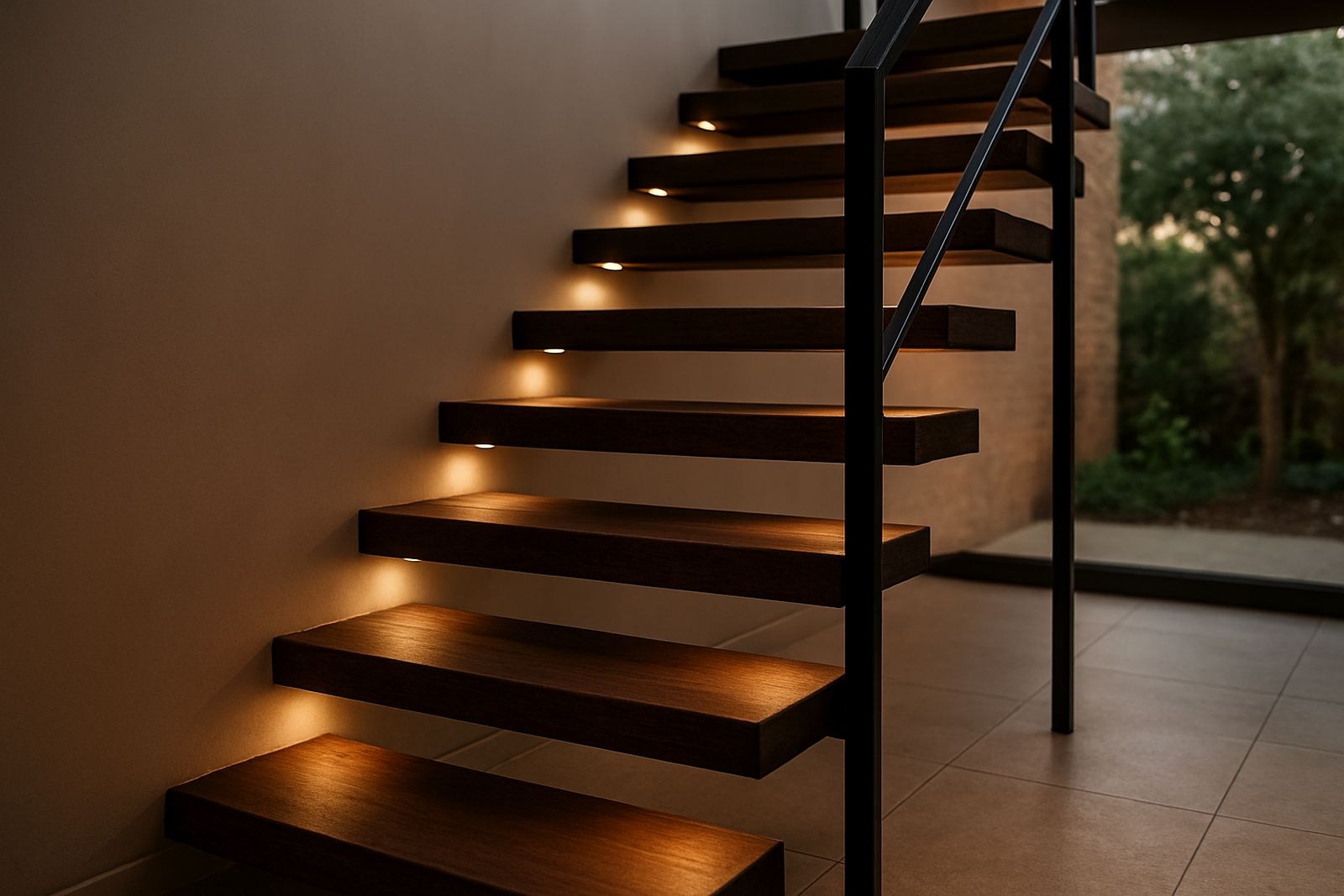
Stair step lights are compact fittings built into the riser, side wall, skirting line or adjacent structure so each step is easier to see after dark. They give a softer pool of light than a ceiling fitting, which means the tread edge is visible without glare in the eyes. For homes in Rosebank or Sandton, they suit internal stairs, entrance stairs and split levels. For restaurants and shopfronts, they also help guide customers neatly from parking or pavement to the front door.
The best stair lighting does two jobs at once: it improves safety and it makes the stair run look intentional. On darker winter evenings, during load-shedding, or where there is little natural light, the difference is immediate. In a well planned installation, the light reads as a slim line rather than a visible dot, so the stairs keep their clean shape and the finish stays elegant.
Sizes, beam styles and finish options
Step lights are usually selected by the size of the stair, the mounting position and the amount of light needed. Some projects call for very small fittings that sit almost flush, while others need a wider face to spread light across a deep tread. The right choice depends on whether the stair is narrow and private or wide enough for public use. For coastal homes in Umhlanga and Durban, the finish should also suit humidity and salt air.
Typical options include recessed or surface mounted fittings, warm white or neutral white output, and trims in black, white, brushed metal or paintable finishes. Illumin8d also considers beam angle, lumen output and dimming so the stairs are bright enough without becoming harsh.
- Mini recessed step lights for narrow treads and subtle visibility
- Wider aperture fittings for long stair runs and public circulation areas
- Warm white output for homes and restaurants, neutral white for sharper task lighting
- Powder coated or corrosion resistant finishes for higher moisture areas
Where stair step lights work best
These lights suit almost any stair where people move after dark or where a polished look is important. In homes, they are common on internal stairs, entrance steps, cellar stairs and garden stairways. In restaurants, they help define the route between dining areas, toilets and exits. In shopfronts, they draw attention to split-level entries and make arrival feel more controlled.
They are especially useful where the stair edge is visually similar to the floor, such as dark tiles, timber treads or polished concrete. They also help in properties where the staircase changes direction or has open risers, because the extra light gives the user a clearer sense of depth. In Pretoria and Midrand, where evening entertaining is common, stair lighting often forms part of the wider decorative scheme rather than a purely practical add-on.
- Indoor residential stairs and split levels
- External entrance steps and courtyard stairs
- Restaurant access routes and feature staircases
- Shopfront entries, terraces and mezzanine access
Installation, wiring and power requirements
Most stair step lights run on low-voltage LED systems, usually stepped down through a driver or transformer hidden in an accessible service point. That keeps the fittings efficient and makes them suitable for long daily use. A proper layout should be planned before tiling, plastering or cladding is finished, because the wiring route and fitting depth must be known early. In many projects, a site lighting audit is the best starting point so the installer can see exactly where the stair structure, wall build-up and switch points sit.
Illumin8d coordinates the layout, control design and installation sequence so the lights work with the rest of the building. For homes, this often includes a simple wall switch or motion control. For commercial spaces, dimming zones and timed control may be better. There is no gas requirement, only a suitable electrical supply and safe access to the driver and fittings for future service. In areas affected by load-shedding, it is worth checking how the stair lights will behave on backup power or inverter circuits.
- Allow for concealed cabling before final finishes are closed up
- Keep drivers and joints in an accessible service position
- Use dimming or timed control where the stair is used after hours
- Check inverter compatibility if the property runs backup power
Care, cleaning and long term servicing
Step lights need little day to day care, but they should be kept free of dust, plaster residue and cleaning chemicals that can dull the lens. A soft cloth and mild cleaner is usually enough. On coastal properties, fittings should be checked more often for corrosion, especially where steps face sea air or where moisture can collect under a tread lip. If a fitting sits low to the ground, mud and garden debris can also build up around it.
It is sensible to have the lights checked after major building work, a repaint or a change in flooring. If one light begins to dim, flicker or look uneven compared with the others, it may point to a driver issue, loose connection or lens contamination. Regular post install focusing is useful on schemes with multiple step runs, because even a slight shift can change the light line. A tidy service plan keeps the stairs looking consistent and avoids small faults becoming a bigger repair later on.
What to confirm before you order
Before ordering stair step lights, check the stair dimensions, material build-up and finish you want to achieve. A good brief should say whether the lights are for indoor or outdoor use, how many steps are involved, and whether the look should be discreet or more visible. It also helps to know if the stair has concrete, timber or steel structure, because that affects fitting depth and installation method.
For a clean result, confirm these points first:
- Exact tread width, riser height and stair count
- Mounting position, such as riser, side wall or skirting line
- Warm white, neutral white or dimmable output
- Indoor, outdoor or coastal grade finish requirements
- Whether the lights must work with backup power
- Access for maintenance after installation
Illumin8d can help assess the site, set out the layout and coordinate the fitting sequence so the final result suits the building and the people using it. For projects in Johannesburg, Pretoria, Cape Town, Durban, Umhlanga and surrounding areas, the aim is simple: safe footing, neat lines and lighting that belongs to the space rather than shouting over it.
Key facts
| Product type | Integrated stair step lighting |
|---|---|
| Light source | LED low-voltage fittings |
| Typical output | About 80 to 250 lumens per fitting depending on size |
| Colour temperature | Warm white 2700K to 3000K or neutral white 4000K |
| Mounting options | Recessed, surface mounted, riser mounted or side wall mounted |
| Typical use | Indoor and outdoor stairs, home entries, restaurants and shopfront access |