Why the front door matters more than people think
An entrance is the first cue a visitor reads. If it is too dark, they hesitate. If it is too bright, they squint and keep moving. In South African towns and cities, that first few metres often has to deal with harsh midday sun, evening traffic, security concerns and changing power conditions, so the lighting has to do more than look nice.
For a shopfront in Rosebank or Sandton, the doorway should guide people from pavement to threshold without confusion. In a restaurant in Durban or Umhlanga, the entry should feel warm enough to slow a guest down. At home, especially in suburban streets or coastal areas, the goal is clear visibility with a calm, welcoming feel.
- Make the door frame easy to read from the street
- Light steps, thresholds and changes in level first
- Use warm tones where people pause, not glare
- Keep signage and house numbers legible at night
Start with visibility, then layer in atmosphere
Many entrance problems begin with one light point placed in the wrong position. A downlight above the door may be enough for a flat passage, but it can leave faces in shadow and create harsh reflections on glass. Better planning uses layers: a practical layer for safety, a visual layer for the doorway, and an accent layer for the feature wall, signage or canopy.
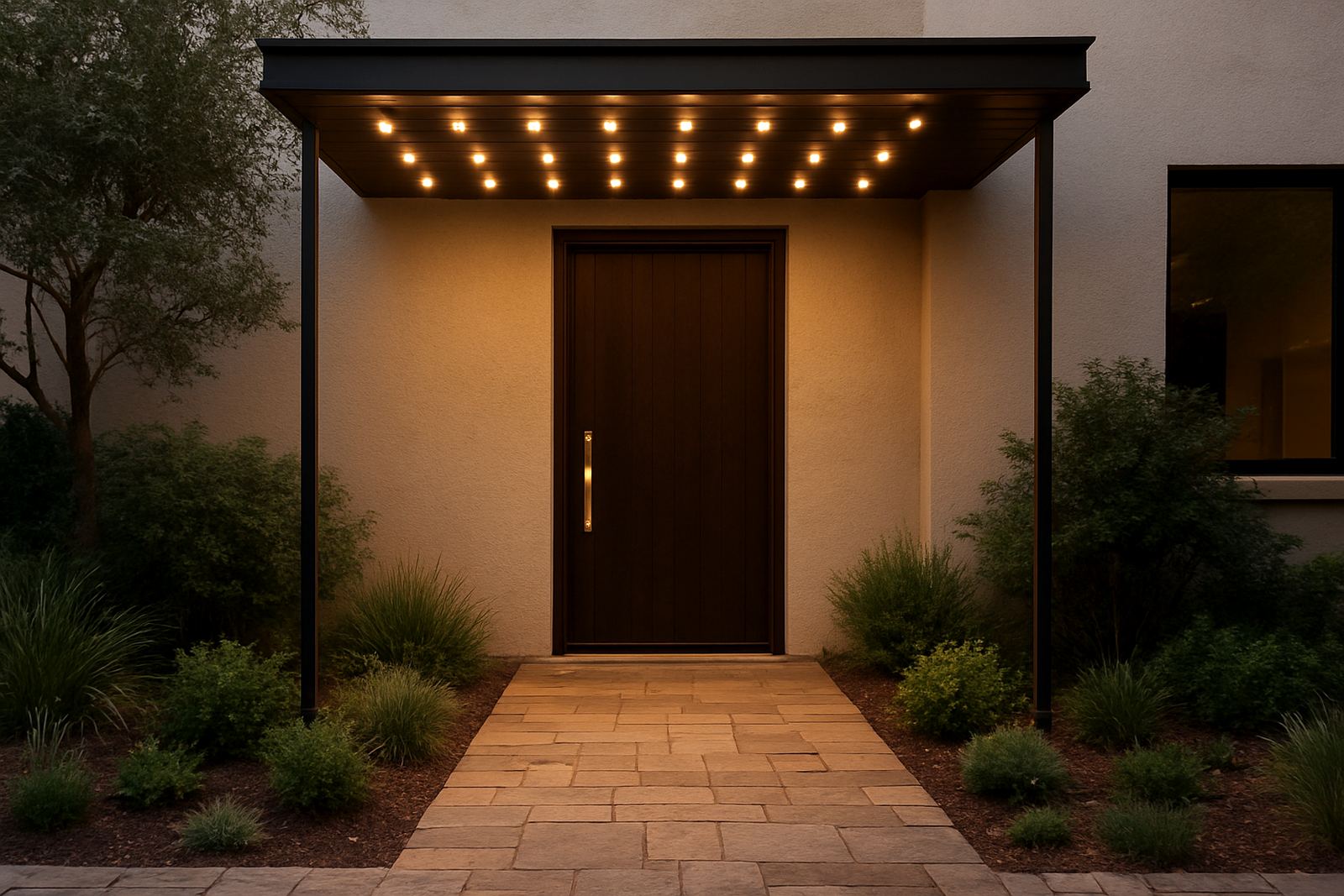
We usually look at how a person approaches the entrance from the car park, pavement or driveway. That route should be obvious from 10 to 15 metres away. A well placed wall light, concealed strip under a canopy, or narrow beam fitting above a sign can give direction without overlighting the whole frontage.
- Use the brightest light where the feet land, not only above eye level
- Keep light off the road and neighbouring windows where possible
- Choose fittings that handle rain, dust and coastal humidity
- Plan for energy use so the entrance still works during load-shedding
Shopfront entrances need invitation and control
For retail, the entrance is part of trading. It should draw attention from the street, but still allow people to see inside without being blasted by light. In Johannesburg and Pretoria, where many retail areas face bright reflections and late trading hours, the right balance is important. A dark doorway can look closed. A too-bright one can look harsh and uninviting.
Good shopfront lighting starts with the fascia, the doorway and the glazing line. If there is a display near the entrance, light it enough to pull the eye inward. If the shop has a recessed entry, use side lighting or concealed linear light to define the recess. That way the entrance feels intentional, not like an afterthought.
- Highlight the door surround or brand panel, not every surface
- Use consistent colour temperature across the frontage
- Choose dimming or timed control for trading hours
- Check how the entrance looks from the opposite side of the road
Restaurant doors should feel warm before the first greeting
Restaurant entrances do not need to shout. They need to invite. A guest walking up from a parking area or sidewalk should feel that the room inside is ready for them. Warm light at the door, a soft glow on the threshold, and careful accenting on textured finishes can make the entry feel relaxed before anyone speaks.
In Cape Town, where wind and salt air can affect fittings, and in coastal Durban where humidity stays high, material choice matters just as much as beam angle. We look for fittings that can be maintained easily and positioned so they do not collect water. On the inside edge of the entry, a softer level of light helps guests adjust from street brightness to interior dining light.
For restaurant entrances, the best result is often a quiet one: no glare, no patchy shadows, just a clear route and a sense that the space is open for service.
Home entries should welcome people and keep them safe
At home, the front entrance has to do a few jobs at once. It should help family and visitors find the door after dark, make keys and locks easy to use, and create a sense of arrival. In many suburbs around Johannesburg and Midrand, the front gate is separate from the front door, so both points need thought. The gate may need broader coverage, while the door needs softer focused light.
We often suggest a mix of wall lights, step lighting and a discreet fitting near the door canopy. If there is a porch or verandah, the light should cover faces clearly for security and conversation. Motion control can be useful, but it should not switch on so aggressively that it startles guests every time they arrive.
- Light the path from gate to door in clear sections
- Keep the entrance number readable from the street
- Use fittings that suit the boundary wall height and finish
- Allow for maintenance access so bulbs or modules can be replaced without fuss
Controls, maintenance and load-shedding proofing
Entrance lighting only works if it stays practical. That means planning controls as carefully as the fittings themselves. Timers, photocells and dimmers can help a frontage stay consistent from early evening through closing time. In business areas, this also helps with energy use and operating costs. For homes, it means the entrance is ready before the household comes back after dark.
We also plan for the day-to-day realities that South African clients live with. During load-shedding, a front light on a backup circuit or low-consumption control system can keep the entrance usable. On exposed sites, regular cleaning matters too, especially where dust, pollen or sea air can dull lenses and reduce output.
If a fitting cannot be reached for cleaning or servicing, it is not a good choice for an entrance. The front of the property should stay neat, with no dangling cords, visible cable runs or mismatched fittings that age badly.
A Rosebank example that shows the difference
We recently worked on a street-facing entrance in Rosebank where the client wanted a clearer arrival point without making the frontage feel overdone. The site had glass, stone and a recessed door, with foot traffic from both the pavement and a small parking area behind the building. The first issue was glare from a bright fitting above the door. The second was that the step down into the entry was hard to read after sunset.
We adjusted the approach with a controlled wall wash, low level step lighting and a softer highlight on the doorway itself. The result was simple: people found the entrance more easily, the frontage looked calmer, and the space felt open after dark. It did not need more light, just better placed light.
That is usually the real answer with entrances. Most of the time the aim is not to brighten everything. It is to guide, welcome and settle the eye.