
What kitchen island pendants do in a working kitchen
Kitchen island pendants are suspended fittings placed above an island or prep counter to light the work surface directly. In practical terms, they help you chop, read recipes, plate food, and keep the island usable after dark without flooding the whole room with light. A good pendant setup also adds a visual centre point, so the kitchen feels planned rather than simply fitted out.
For homes in Johannesburg, Pretoria, Cape Town, Durban and Umhlanga, island pendants are often used to balance daylight, under-cupboard lighting, and general ceiling lighting. In areas with frequent load-shedding, many clients also prefer pendants that work well with backup circuits or low-watt LED lamps so the kitchen still feels comfortable when the mains go off.
Popular sizes, shapes and finish options
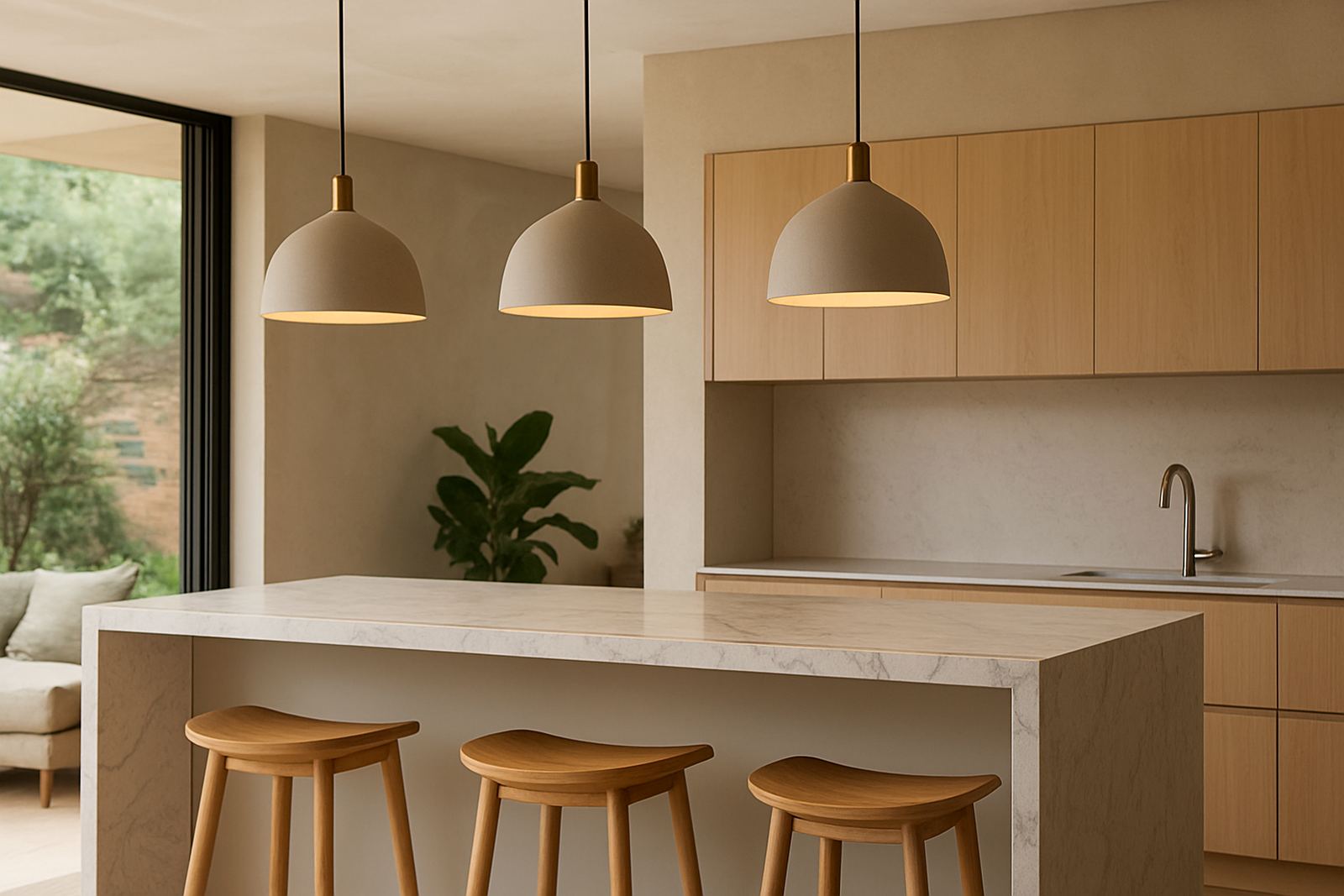
Island pendants come in compact single drops, small clustered sets, linear bar pendants, or multiple matching shades spaced along the length of the island. The right size depends on the island length, ceiling height, and how much visual weight you want over the counter. For smaller kitchens, a pair of 150 mm to 250 mm shades can work well. For longer islands, three pendants or one linear fitting often looks neater.
- Shade diameters commonly range from 120 mm to 400 mm.
- Suspension drops can be set from about 500 mm to 1500 mm depending on ceiling height.
- Finishes may include painted metal, glass, timber detail, natural fibre, or mixed materials.
- Colour choices can be matched to cabinet handles, taps, or stool frames for a consistent look.
We often advise clients to keep enough open sightline across the island so the fitting does not block conversation or the view to the dining area. A pendant should feel deliberate, not oversized. Even a small mis-match in scale can make the room feel off.
Best places to use them at home and in hospitality spaces
Kitchen island pendants suit open-plan homes, breakfast nooks, entertainment kitchens, and scullery-style prep zones where the island does heavy daily work. They are also well suited to restaurants, coffee bars, tasting counters, guest house kitchens, and boutique hospitality spaces where presentation matters as much as function.
In coastal areas such as Durban and Umhlanga, material choice matters because salt in the air can affect finishes over time. For those sites, we usually look at more stable metals and quality coating systems. In hotter kitchens or busy family homes, easy-clean surfaces are worth prioritising because grease and steam build up faster than people expect.
- Residential kitchens with islands or peninsulas
- Restaurants and cafés with service counters
- Show kitchens and display areas
- Hospitality suites and guest entertaining spaces
Installation details, power needs and control options
Before installation, the ceiling point, island position, and ceiling height must be checked carefully. Pendants should hang low enough to light the worktop, but high enough not to interfere with sightlines or a person standing at the island. As a general guide, the bottom of the fitting is often around 700 mm to 900 mm above the countertop, though this varies with shade size and room proportions.
Most kitchen pendants use LED lamps or integrated LED light sources because they run cooler and use less power. That makes them a sensible choice for households managing energy costs and load-shedding. Dimming can be helpful too, especially if the island doubles as a dining spot in the evening. If the home uses a backup supply, it is important to confirm the circuit load and switching setup before finalising the fitting. A neat install starts with proper support in the ceiling, exact centring over the island, and clear allowance for cable length. If the electrician and installer are not aligned, the result can look crooked even when the fitting itself is fine.
Care, cleaning and longer-term servicing
Kitchen pendants live in a tough spot. They sit near steam, cooking oils, and dust, so regular care keeps them looking good and performing properly. Wipe the shade and hardware with a soft dry or slightly damp cloth, and avoid harsh cleaners that can dull painted finishes or leave marks on glass. If the pendant has textured surfaces, a soft brush helps lift dust from grooves and edges.
For integrated LED fittings, check that the light output remains even and that no flicker develops after repeated power interruptions. If the pendant is dimmable, make sure the control gear is still working cleanly, because poor dimming often shows up first at low levels. Periodic servicing may also include checking suspension points, cable tension and alignment over the island, especially after a room repaint or cabinet change.
What to check before you place an order
Getting the brief right at the start saves time later. Measure the island length and width, note ceiling height, and decide whether you want one statement fitting or a grouped arrangement. It also helps to know if the island is used mainly for prep, breakfast, homework, or entertaining, because the light level and style may differ. A brushed finish that looks good in the showroom may read very differently under warm kitchen lighting at night.
- Island dimensions in millimetres
- Ceiling height and ceiling type
- Power point location and switching position
- Preferred light colour, usually warm white for kitchens
- Whether dimming is needed
- Any open shelves, extractor hoods, or hanging obstructions nearby
It is also worth checking how the pendant will sit alongside stools, cabinetry, and splashbacks. If the shade is too wide or too low, it can crowd the space and make the counter feel smaller than it is.
How we help with kitchen island pendant projects
For projects in Rosebank, Sandton, Midrand, Pretoria, Cape Town, Durban and Umhlanga, our team assists with concept design, fixture specification, layout planning, mockups and samples, and installation coordination where needed. We look at how the pendant fits the room, how it performs as task lighting, and how it relates to the rest of the finishes in the space.
If you are choosing pendants for a new kitchen or replacing an old fitting, start with the island measurements and a few photos of the room in daytime and at night. That gives us a better basis for recommending size, drop, finish and control setup. Small details make a big difference here, and getting them right means the island works properly from day one.
Key facts
| Product type | Kitchen island pendant lighting |
|---|---|
| Typical use | Task lighting and decorative centre point over islands and counters |
| Common sizes | 120 mm to 400 mm shade diameters |
| Typical drop range | About 500 mm to 1500 mm, depending on ceiling height |
| Light source | LED lamp or integrated LED options |
| Best suited to | Homes, restaurants, cafés, guest spaces and show kitchens |